Sunday, December 16, 2012

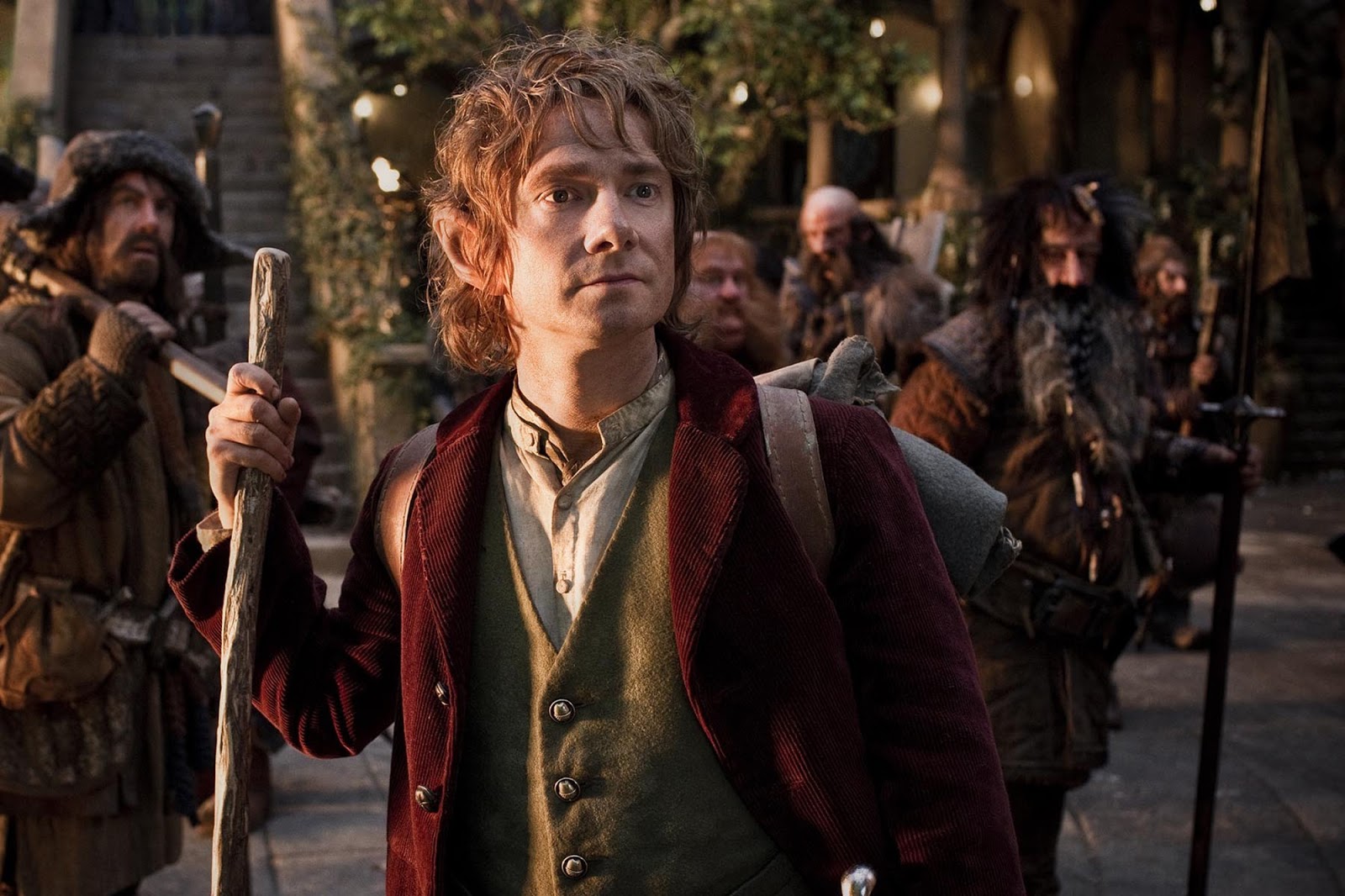
The Hobbit: An Unexpected Journey


"Saruman believes it is only great power that can hold evil in check, but that is not what I have found.  I found it is the small everyday deeds of ordinary folk that keep the darkness at bay:  small acts of kindness and love.  Why Bilbo Baggins?  Perhaps because I am afraid, and he gives me courage."  - Gandalf the Grey, The Hobbit: An Unexpected Journey

Too often, we think like Saruman.  It's time to think more like Gandalf.  Or perhaps even more appropriately, it's time to act more like Bilbo Baggins.

The Hobbit: An Unexpected Journey takes us on another J.R.R. Tolkein adventure.  Over a decade ago, director Peter Jackson gave us the incredible story of The Lord of the Rings trilogy, Tolkein's masterpiece in cinematic form.  This time, however, we go back farther into the history of Middle Earth, before the fellowship and the ring, when the object of the journey wasn't saving the world, but simply reclaiming one's home.

As we begin this tale, we meet Gandalf again (Ian McKellen) encouraging young Bilbo Baggins (Martin Freeman) to accompany thirteen dwarfs on a epic adventure to the Lonely Mountain - the "Promised Land" of the dwarfs that had been overtaken by the dragon Smaug sixty years prior.  The colorful collection of lost dwarfs is led by the great warrior Thorin Oakenshield (Richard Armitage), and they need a hobbit like Bilbo to sneak into places they cannot.

Bilbo doesn't seek this adventure, but he ultimately decides to join the dwarfs anyway - mostly because he takes pity on their homelessness (and for a hobbit like Baggins, having a comfortable home is a blessing all creatures should have).  Despite thoroughly enjoying his comfort zone, Bilbo has a compassionate heart and generous spirit - one that Gandalf saw in him before he saw it himself.

Of course, some on the high and mighty White Council doesn't share Gandalf's vision.  This Council, you see, is made up of really important people like Gandalf and his fellow wizard Saruman (Christopher Lee), Elrond (Hugo Weaving), the elf lord of Rivendell, and the Lady Galadriel (Cate Blanchett), the mightiest and fairest of the elves in Middle Earth.

In a private conversation with Galadriel, Gandalf confesses that he puts his faith in simple, ordinary people rather than in great powers like the White Council.  "Saruman believes it is only great power that can hold evil in check, but that is not what I have found," declares Gandalf.  "I found it is the small everyday deeds of ordinary folk that keep the darkness at bay: small acts of kindness and love."

Whether it is facing off against the dragon Smaug, or the growing threat of the Necromancer, or any form of malevolent trolls, goblins, or orcs, Gandalf chooses to put his bets on those like Bilbo or the quietest of the dwarfs over wizards, elves, or kings.

Too often, we think as Saruman does:  we put our faith in seemingly important people to solve all our problems.  We tend to put our bets on politicians, celebrities, corporate heads, media figures, and household names - locally or globally.  We bet on them to fix our economy, eradicate crime and poverty, and bring peace and happiness to our worlds.  And too often, they don't deliver.

Perhaps it's time to think as Gandalf does:  to put our faith in others and in the gifts God has given to us, rather than waiting for some greater power on earth to solve everything for us.

As I write this, I am troubled by the recent tragedies of gun violence in Colorado, Oregon, and most recently, Connecticut.  Yet in the midst of this darkness comes the story of "ordinary folk" like Vicki Soto who sacrificed her life so that others might live at Sandy Hook Elementary School in Newtown.  People like Vicki "keep the darkness at bay" for she gives us an example of selflessness and love that we can all follow.  She, and others like her, are truly lights in the darkness of such horror.

We need to believe in people like Vicki Soto in our own lives.  Who are the kind, loving, and compassionate souls we know - who get little recognition for the little things they do to make this world a better place?  And how can we ourselves become more like Vicki, by being selfless in the face of violence, hatred, and darkness in our daily lives?  

Like Gandalf, God puts his faith in people like this.  Even in the person of Jesus Christ, God trusted the salvation of humanity to a man who lived his whole life in poverty, who walked up and down unmarked roads of a forgotten Roman province, and who died the death of a forsaken criminal.  The Father didn't trust in the great powers like kings, emperors, or high priests for the task of redemption - but in the simplicity and ordinary life of a Galilean peasant.

And also like Gandalf, we grow frightened.  But let people like Vicki Soto give us courage and strength.  We may not be president, pope, or king, but that just means we have even more power to hold darkness at bay and to change the world.  

Let us pray for Christ to live in more "ordinary folk" like you and me and those in our everyday lives - and in so doing, let us pray for great things to happen because of these people!

Saturday, November 17, 2012

Lincoln

"With malice towards none, with charity for all, with firmness in the right as God gives us to see the right..."  Abraham Lincoln, March 4, 1865 (Second Inaugural Address, Washington DC)

Steven Spielberg's epic Lincoln is a magnificent study in character.  The screenplay itself is a bit long and winding, full of 19th Century political intrigue and all the details of domestic life in the White House at the end of Lincoln's presidency. But what cannot be denied is the incredible richness that the actors brought to the historical characters we see on screen.

First and foremost, Daniel Day-Lewis does a remarkable job embodying the sixteenth president.  For over two hours, we get to see Abraham Lincoln as never before - a mix of humor, zeal, compassion, and melancholy in the face of the United States' most divisive period of history.

Day-Lewis shows us a man who was politically shrewd but firm in his convictions that slavery was wrong and all people must be treated equally and with loving compassion.  And to calm himself in a daily grind that would break most people, Lincoln is seen here as a simple country boy who loved telling campfire stories in whatever setting he found himself - from the war room to the bedroom, with soldiers, congressmen, servants, and whoever would listen to him.    

We know of oft-repeated statements the historical Lincoln once proclaimed, "A house divided against itself cannot stand..," "Four score and seven years ago...," and from his Second Inaugural Address, "With malice towards none, with charity for all,, with firmness in the right as God gives us to see the right..."  But up until now, excepting students of history, few of us knew the humanity behind such grand eloquence.

In this film, we understand the complexities of the man:  political yet personal, calculating yet compassionate, commanding yet willing to listen to those around him.  Decades now removed from this man, we often wonder why those on the right and left, the conservative and liberal, the religious and irreligious all hail Lincoln as a hero.  Lincoln shows us one possible reason... the man was truly a man for all seasons: a balancing act on the tightrope of history.  

As we seek balance and tapping into all the gifts God has given us, we can look to Abraham Lincoln as a role model.  While our daily struggles are not keeping the Union intact in the face of secession, they can seem so.  It can be easy to verge to one side or another - to be aggressive without compassion, or to be melancholy without hope - but we are called to live on a similar tightrope - and like Lincoln, make it across to the other side, whenever that end may come for us.

Daniel Day-Lewis is certainly the focal point for the film, but there are other great studies of character: Mary Todd Lincoln (Sally Field), the devoted wife whose life seems to be crumbling around her, yet kept stable and calm by a loving and solid husband - and my personal favorite in the film, Tommy Lee Jones as Thaddeus Stevens, the radical Republican abolitionist whose dreams of racial equality are unfolding before his eyes in the last four months of Lincoln's presidency.

For much of the movie, Stevens appears as a curmudgeon, bitterly fighting what seems like a losing battle (with political views that are about a century ahead of his time).  He bristles with fellow congressmen, political opponents, and the president himself.  Stevens demands perfection from society, and that perfection cannot come soon enough for him.  Anyone who gets in the way of that utopia is often on the receiving end of Stevens' fiery sermons and political speeches.

We may be or we may know people like Stevens, angry and bitter - and a person others may not want to be around.  Tommy Lee Jones is an actor who probably didn't need to do much acting for this part, either.  He gives us a portrayal that we both support and cringe at the same time.

But once again, Lincoln shows us that character is everything - and the entirety of that character is not necessarily what we see on the surface.  Late in the film, we come to find out the reason for his single-minded dedication to abolition and equality, and as radio commentator Paul Harvey often said, "and that's the rest of the story."

Character is important.  Character is key.  Lincoln was one that shown marvelously in public, and Stevens is one that was defined by what was private.  We should not be quick to judge one or the other too quickly, for like each one of us, there is much more of the story yet to tell.

Perhaps that is why Spielberg took two-and-a-half hours to tell this story.  Real character is not something that can be assessed in a moment.  It takes depth and time.  It takes patience.

As we look around to the people and characters in our own lives, perhaps we need to take some time there as well - to truly understand who it is that God has placed along our path.  Our judgements of others can come quick, like those who quickly assessed Stevens or Mary Todd... or even Lincoln.  Chances are, behind even the most private of people, there is a grand story yet to be told.  May we discover those stories - and be willing and compassionate enough to enter into them in new ways.

Sunday, November 11, 2012

Skyfall

"Where, O death, is your victory?  Where, O death, is your sting?"  1 Cor. 15:55

Please note that this review contains a few spoilers.

You just can't keep James Bond down for long.  For fifty years, Ian Flemming's infamous MI6 agent has escaped from the clutches of death time and time again.

In the opening sequence of the latest (and one of the greatest) 007 film, Skyfall, James Bond (Daniel Craig) is shot and presumed dead.  And even though an obituary is written for him, death just doesn't suit our hero very well.

Later in the movie, when asked by the central villain Raoul Silva (Javier Bardem) about his hobbies, Bond quickly replies with "resurrection."  Over the years, 007 has escaped death countless times (one fan noted 4,662 to be exact), yet this latest "demise" gives him some time to reflect on his mortality and what is truly important to him (while recovering on some tropical island somewhere).

Yet death has no power over James Bond it seems.  Though quite far from the moral integrity of Jesus of Nazareth (and not counting the fact that one is the Son of God and the other a fictional character), the two do share an uncanny knack for surviving persecution and death in order to save the world.

"Where, O death, is your victory?  Where, O death, is your sting?" asks St. Paul (1 Cor. 15:55).  In this latest incarnation of Bond, we see our hero becoming a man whose whole existence revolves around protecting the innocent and punishing those who oppress, persecute, and destroy.  And with this as his central mission, death truly has no power.

We love watching Bond in part because we wish we could do all that he does - and with such class and sophistication.  It's impossible, right?  To some extent, yes.  We are not British secret agents with a license to kill.  But to some extent, we can be like Bond.

Bond has his convictions:  to protect, defend, and out-maneuver those who hurt others.   Should this not also be our mission?  Jesus instructs us to protect the defenseless and "be as cunning as snakes, yet as harmless as doves." (Mt. 10:16).  How do we stand for the vulnerable - the unborn, the poor, the persecuted, and the marginalized?   If and when we do this, we are honing our inner James Bond.

Bond also has his obedience.  No matter how unconventional his methods, he is loyal to Britain and in particular his demanding boss M (Judi Dench).  Whatever he may think of her prickly personality or rejection from the agency or the bureaucrats, he will always put aside his self-interests in the service of Mother Country.  The same should apply to us.  While we may think ourselves fully capable of doing anything, there are times we must be obedient to those in authority (from those on this earth to God above in heaven) who have a bigger picture than us.  It can be challenging to do in this in an age of individualism, but it certainly does Bond well.  Why not us too?  

Finally, Bond has a respect for traditions.  From his martini choices (shaken, never stirred) or his vehicle of choice (the Aston Martin DB5, which makes a nice return in Skyfall), Bond is a traditionalist.  In this movie's final act, Bond says "It's time to go back to the past."  The only way to defeat his nemesis Silva is to bring him into his past, whether he is proud of it or not.  The same must go for us.  When we keep to the traditions of our faith, our country, and our own experience - not being caught up in the brightest, shiniest object of the present moment - we can do great things.  Let us not forget where we come from, and the principles that have guided us for years.

When we stick to our core convictions, our traditions, and obey higher powers, we can become our own version of James Bond.  And if we live with integrity, compassion, love, and fidelity to God, then we can not only evade death like 007, but we can conquer it.

"Death will be swallowed up in victory," St. Paul says (1 Cor. 15:54).  When we live as Christ with conviction, tradition, and obedience, death will truly have no power over us.

Sunday, October 14, 2012

Argo

"When you give of yourself, do not let your left hand know what your right hand is doing, so that your almsgiving will be done in secret."  Matt. 6:3-4a

Argo is a declassified tale of real-life events that transpired in 1979 and 1980 during the Iranian Hostage Crisis and the rise of the Ayatollah Khomeini.

While 52 Americans were held hostage after militant students broke into the United States Embassy in Tehran, six escaped into the homes of Canadian ambassador Ken Taylor (played here by Victor Garber) and (though not represented in the film) Canadian immigration officer John Sheardown.

Meanwhile in the U.S., CIA specialist Tony Mendez (portrayed by Argo director Ben Affleck) engineers a fantastic scheme to extract the six hiding with the Canadian officials:  in the wake of the science fiction renaissance brought on by Star Wars in the late 1970s, Mendez will travel to Iran as a Canadian film producer looking to film a low budget sci-fi adventure in the exotic locale of Tehran and leave a few days later with his six-person "production crew," that is the six American diplomats.

The ruse seemed so fantastic it was believable. To ensure credibility, Mendez brings Hollywood into the act by bringing aboard sci-fi make-up artist John Chambers (John Goodman) and producer Lester Siegel (Alan Arkin).  They develop storyboards, scripts, marketing, and actors - all kept in the dark on the ultimate purpose of their work:  to save American lives overseas.

For years, President Jimmy Carter, along with the real-life Ambassador Taylor, Sheardown, Mendez, Chambers, the six diplomats, as well as all those in the White House, State Department, and CIA who were involved with this covert operation, kept quiet on the details.  It wasn't until 1997 when President Bill Clinton declassified this story.

Secrets can often lead to corruption, but in this circumstance, it saved lives.

There is always a delicate balance between keeping information hidden, and we're not just talking about CIA missions or declassified stories. When it comes to our relationships with others, we don't want to exclude others from the facts; but at the same time, there is a place for discretion.

We live in the tension:  What do we share with others?  What do keep to ourselves?  Which of our actions should be tell others about?  Which should we keep hidden?

During one of his most memorable teaching moments in the New Testament, Jesus dealt with this internal conflict.  In the Sermon on the Mount, he spoke of three instances where secrecy is not only allowed, but encouraged:  in our prayer, in our fasting, and in our almsgiving.

"When you give of yourself, do not let your left hand know what your right hand is doing, so that your almsgiving will be done in secret." (Mt. 6:3-4a)   We live in a time when self-promotion is the norm, when reality television demands that nothing be kept secret.  Jesus' words increasingly fall on deaf ears.

Even in our churches, charities, and schools, we engrave plaques with donors and give prizes for those who do the most community service.  Practicing churchgoers often wear clothing, jewelry, or drive in cars labeled in a way that tells the world about one's religiosity.

Yet, despite other less-than-admirable actions, the CIA can teach us a lesson in discretion.

In Argo, one could argue that, even though he is credited for Spock's ears in Star Trek, Herman Munster's look in The Munsters, and the primates in Planet of the Apes, John Chambers' greatest accomplishment was saving the lives of six diplomats, not to mention Tony Mendez, Ambassador Taylor, and others in the Canadian embassy.  And for twenty years, he had to keep it completely secret.  His truest masterpiece was never to be known.

The same goes for Mendez, the Canadian government, and Jimmy Carter, who - in part - lost the 1980 election due to the public's assessment that he had been successful rescuing anyone from Tehran.  Their secrecy not only helped those stranded in Iran, but also reminded us of the importance of Jesus' words: "do not let your left hand know what your right hand is doing."

It should also remind us not to judge others too quickly for their seeming lack of charity, spirituality, or discipline.  Perhaps, in secret, they are doing what Mendez, Chambers, and others once did.  Let us also remember that Jesus follows up his statements on discreet prayer, fasting, and almsgiving (in Matthew chapter 6) with an admonition against judging one another (in Matthew chapter 7).

So is there a dividing line between what should kept secret and what should be shared?  I believe so, yet I also think that such a line is different for each person.  In their hearts, they will know when they are pushing the envelope too far, stepping over that line for one's own glory.  When we act with humble hearts and do what is right for God, for ourselves, and for others, we will know what is best.

In the meantime, let us pray (discreetly, of course) that our minds and hearts will be more occupied by our desire to do those good things for the Kingdom of God - rather than to worry about how often we should reveal those deeds to the world.  

Sunday, October 07, 2012

Taken 2

"For the measure with which you measure will, in return, be measured out to you." (Lk. 6:38)

In the first Taken movie (2008), Bryan Mills (Liam Neeson) wreaked havoc across Paris to find his daughter Kim (Maggie Grace), who had been kidnapped and sold into prostitution by an Albanian human trafficking syndicate.  Using his training as a CIA operative, Bryan kills and tortures anyone that gets in his way, but ultimately tracks Kim down and saves the day.

Like so many other heroic tales in the movies, we pay little attention to the body count as long as the goal of the film is accomplished: find the girl, defeat the villains, save the world, and so forth.

However, Taken 2 is the story of "what happens next."  It reveals that, while Kim was saved from a life of prostitution, there are consequences to the extreme measures taken to rescue her.  In the first film, Bryan killed many people including the gang of Albanians that kidnapped Kim at the Paris airport.  Now the Albanian father (Rade Serbedzija) of one of those men wants revenge.

Our actions have consequences.  In the laws of physics, for every action there is an opposite reaction.  In the Scriptures, Jesus says without hesitation, "For the measure with which you measure will, in return, be measured out to you." (Luke 6:38)   And St. Paul, in his letter to the Galatians, offers sage advice, saying, "...for a person will reap only what he sows." (Gal. 6:7)

For Bryan Mills, his singular focus on saving his daughter, no matter how noble, made him destroy the lives of others.  Now we see that those actions have serious consequences, as the Albanians out for revenge will stop at nothing in their resolve to punish our hero.  They seek to, once again, kidnap Kim along with her mother Lenore (Framke Janssen) and Bryan himself - and destroy them.

As the Book of Proverbs says, "Whoever sows injustice will reap calamity, and the rod of his fury will fail" (22:8)

Looking inward at our own lives, do we get so caught up in a singular focus or task that, like Bryan Mills in the first movie, neglect to reflect on the consequences of our actions as we move toward that goal?  For instance, are there times when we get so focused on getting a job done at work that we ignore our colleagues or family members in the process?  Or is there a cause that is so noble and for which we are so incredibly passionate about, but because of our passions, we end up ignoring other matters or end up hurting others in our fight for that cause?

While (hopefully) none of us are like Bryan Mills nor choose to kill without hesitation for our singular focus, we can easily fall into his line of thinking.  We can find ourselves so wrapped up in one thing that we loose sight of so much else.

Our actions have consequences, even (and especially) the ones we don't even realize we're doing.

Perhaps the first movie's Bryan Mills is so entrenched in his CIA training that he never realized that he was destroying others' lives in a passionate struggle to save his.  In this movie, it seems, he begins to notice those consequences.  Even in domestic matters, he has to live with the consequences of his actions in his broken marriage to Lenore or his overprotective relationship with Kim.

We, too, must start to wake up to the actions of our lives.  We have to be more conscious of what we are sowing in our race to the finish line.

In the business world, in an attempt to cut corners and save costs, millions of lives are negatively affected.  For instance, certain retail giants, in their corporate objective to offer customers low costs, choose to save those costs by using labor paid below poverty standards and treated with no dignity.  The same is true with international trade companies (especially those dealing with coffee, tea, and cocoa exports) and Wall Street tycoons.  What if, for a moment, those in the leadership of those companies decided to examine the consequences of their actions?

In another example, there are those who feel so charged up about a certain political or religious issue that they will stop at nothing to make their point.  This doesn't just apply to oppressive governmental regimes and religiously-inspired terrorism, but also to everyday individuals who are so very passionate about their beliefs.  Even in small ways, such zealousness can harm so many others in the process.  What if, for a moment, those who have such strong convictions stopped for a moment to ask themselves what consequences their words and deeds have had - and who or what has been harmed as a result?

Sure, it is fun to watch Liam Neeson crush his way through Istanbul in this movie, just as it was thrilling to watch him in the previous film.   So let us keep our desire for unbridled dedication to the movie theatres and the fictional story we see on screen - and not repeat his actions in our own lives.

Let's let Bryan Mills have his day, but let's be aware of the consequences of our actions in every day we have from here on out.  Let's be conscious of the people who may be hurt by our words or deeds, no matter how noble or profitable they seem to us at the time.

And should we find that we have hurt others in the process, let us pray for our forgiveness and that we might reconcile with those individuals or fix the damage we may have caused.

St. Paul concludes his Letter to the Galatians by saying that those who sow forgiveness, reconciliation, and love in the busy stretch of their lives will reap such blessings as well.  "For the one who sows for the Spirit will reap eternal life from the Spirit.  Let us not grow tired of doing good, for in due time we shall reap our harvest, if we do not give up." (Gal. 6:8-9)

In whatever quest we are on today or those we will engage in tomorrow, let us always sow good works: love, awareness, compassion, and patience - for those are actions with consequences we will most certainly want to receive from the Lord and from others.

Sunday, September 16, 2012

Finding Nemo 3D

"Son, why have you done this? Your father and I have been looking for you with great anxiety!"  Luke 2:48

Disney-Pixar's Finding Nemo has returned to movie theatres to show off its new 3D capabilities, and of course, to bring in a few extra dollars on a guaranteed investment.  Cynicism aside, re-releasing a movie like this is a treat because it really is a great film worth the few extra dollars to see it 3D.

The story is a role reversal of sorts.  Typically with a film about a youth getting lost in the wilderness, the focus is on the growth of the child, and to some degree this is true.  But the emphasis here is on the emotional and spiritual development of the father.

For those who haven't seen the movie or who need a refresher, Finding Nemo is a father-and-son tale of Marlin (voiced by Albert Brooks), a clownfish so scarred by his past that he is fearful of anything beyond his anemone home, and Nemo (voiced by Alexander Gould), a wide-eyed kid with a slight handicap (his right fin is smaller than the left) and a desire to move out of his father's shadow.

On his first day of school, in an attempt to prove he can make it on his own, Nemo is captured by divers on the open ocean and brought to live in a fishtank in a Sydney dentist office.  Meanwhile, despite his fears, Marlin races into the deep to desperately find his son.  On the long journey through the Great Barrier Reef, he meets a cast of characters, but none so important as Dory (voiced by Ellen Degeneres), a Blue Tang fish with a short-term memory problem and a heart of gold.

In a way, Marlin becomes the hero of the story, fighting his way through danger and distance when his son is concerned, proving that love conquers all fear.  When the focus of our life is constantly pointed towards the love of others, we can overcome all odds.  Marlin, a fish normally afraid of anything outside the comfort of his home, was able to swim through dark deep abyss, go headlong into shark-infested waters, navigate among a forest of jellyfish, and make it through the belly of a whale - all for love of his son (and in some cases, love for his annoying companion Dory).

The film itself seems comparable to the experience of Mary and Joseph in the Scriptures, realizing they had lost their son in Jerusalem.  Like Marlin and Dory, they searched everywhere for Jesus - among relatives, in the dangerous city streets, and ultimately, after days and days, finding him in the Temple. (see Luke 2:41-52 for the whole story).

When they find him, Mary turns to Jesus and says, "Son, why have you done this?  Your father and I have been looking for you with great anxiety!" (Lk. 2:48)   To this remark, Jesus says he has been safe and secure all along in his Father's house.  What this does is turn the tables on his parents, and offers them a lesson in their desperate search.

Here the young Jesus asks his parents, and by extension asks us, to look closer at our own journeys of great anxiety.  Often when we are frantically looking for something or to complete something, our focus is on the end goal.  This was especially true of Marlin who was able to use this focus to make it through the vastness of endless sea.  But Jesus also asks us to take a moment and look around us and within us: when we are constantly moving "with great anxiety," we can forget the rest of the world and ourselves.

In his incredible journey to find his son, Marlin often took for granted the blessings he received along the way: the constant companionship of Dory, the unique encounters with oddly compassionate sharks and whales, the helpful wisdom of a school of moonfish, the sage advice of the 150-year old sea turtles gliding through life on the winds of the current, and an aquarium of welcoming fish (and one wayward pelican) in Sydney who protected his son unbeknownst to him.  And despite his closed-off attitude at times, they still wanted to help - and without that, Marlin would still be looking for Nemo.

Today, our lives our often run at an obnoxious pace, frantically searching for something or looking to finish this or that task so we can move onto the next.  We are Marlins swimming upstream.

When we live like this, we can often forget the people around us and the experiences that come to us.  We can be so focused that we don't stop for a moment for gratitude or even rest.  Our idiosyncrasies can go unchecked when we don't listen to the advice of those around us.  While it is true that focus can bring about our goals, let us also not forget that the journey is just as critical as the destination.

Finding Nemo is aptly named, as the time Marlin spent finding Nemo gave us, the audience, a remarkable story.  The reunion of father and son is the hope of the film, but the real joy for us is the journey.  Likewise, when God watches our lives, he may want us to succeed in all our tasks, but he especially enjoys watching how we got there.

Let us pray for each other that we may take a few moments, come up for air like a humpback whale off Australia's coast, and take in all we meet, all we see, and give thanks to God for all we received.

Sunday, August 12, 2012

The Bourne Legacy

"It is not good for the man to be alone..."  Gen. 2:18

In The Bourne Legacy, black ops agent Aaron Cross (Jeremy Renner) finds himself quite alone.

Cross is part of an international network of covert CIA agents spread out across the globe, but after Jason Bourne (Matt Damon) in the earlier movie trilogy exposed the Agency for its corruption and morally vacant tactics, that network is being shut down.

This means that all agents must be eliminated, but due to his increased stamina and heightened intelligence (by-products of his covert operation which have chemically changed his body and mind), Aaron has been able to survive the attack.  When a second drone is sent to kill him in the snowy wilderness of Alaska, he is able to fake his death and avoid further detection from the CIA.

And, in that moment, Aaron Cross is all alone.

Meanwhile, the CIA is also eliminating the scientists who created the chemical formula that fueled those seemingly-invincible covert operatives; and when one scientist, Dr. Marta Shearing (Rachel Weisz) survives that massacre, she too is all alone.

Fortunately, their loneliness does not last too long.  Aaron is able to track down Marta just in time to save her from yet another CIA-ordered attack.

They find, in short order, that they need each other.  Apart, each will inevitably die:  Marta has no training to go up against wiretappers, snipers, government agents, and hungry reporters out to get her without Aaron's special skills and creative evasion tactics; and Aaron will mentally implode without a viral cure that only Marta, with her scientific expertise, can provide.

"It is not good for the man to be alone," God says of Adam in the first chapters of Genesis (2:18).  The same goes for Aaron Cross, for Marta Shearing, and for any of us.  It is not good to be alone - and not because we will be hunted down by the CIA if we were to be.

What pains us when we see the Bourne movies, this one not withstanding, is how alone the protagonist seems to be.  Aaron and Marta, like Jason Bourne before them, are without support and far from the comforting embrace of a community or other kind-hearted souls. They must rely on their own ingenuity and expertise to make it through each moment of these movies.

So it is good that the two in this movie aren't completely alone.  They have each other, and hopefully, over time (i.e. sequels), they will find others to lean upon in times of need.

"I will not leave you alone," says Christ to the disciples at the Last Supper (John 14:18), "...and when this is over, you must come back and give strength to your brothers." (Luke 22:32)   Christ won't leave us alone, and this is possible by reliance on God and reliance on a community who loves us.  So, too, we must find those who will never abandon us - and we, in turn, must not abandon those whom God has given us in our lives.

For all his chemically-induced powers, Aaron Cross is nothing without Dr. Shearing.  And for all her intelligence and experience, she is powerless without him.  Who are those people in our lives who give strength to our weakness, and whom we strengthen in theirs?

It is not good for us to be alone, but in our culture of self-reliance and individuality, we can be tempted to forge our own way in the wilderness, like the cover operatives in the beginning of this film.  We can do it by ourselves, we fool ourselves into thinking.  But if that were the case, each of us would have our own planet upon which to exist.

Instead, God created us today with over seven billion other companions on this earth.  We are strongest when we do not run alone, when we look to the common good above our own, and when we strengthen and seek strength from one another.

In that spirit, let us pray for each other, and in our common prayer, we will never ever be alone again.